
Class 7 Worksheet on Formal and Informal Style
Class 7Free DownloadPDF

Arzoo KhanVisit Profile
I’m a friendly and dedicated English teacher who helps children learn with confidence and ease. I create a comfortable and supportive environment where students are not afraid to make mistakes and are encouraged to believe in themselves.
Class 7 Worksheet on Formal and Informal Style
Class 7Free DownloadPDF
Arzoo KhanVisit Profile
I’m a friendly and dedicated English teacher who helps children learn with confidence and ease. I create a comfortable and supportive environment where students are not afraid to make mistakes and are encouraged to believe in themselves.
Speak Smartly: Formal vs Informal Sentence Structure for Class 7
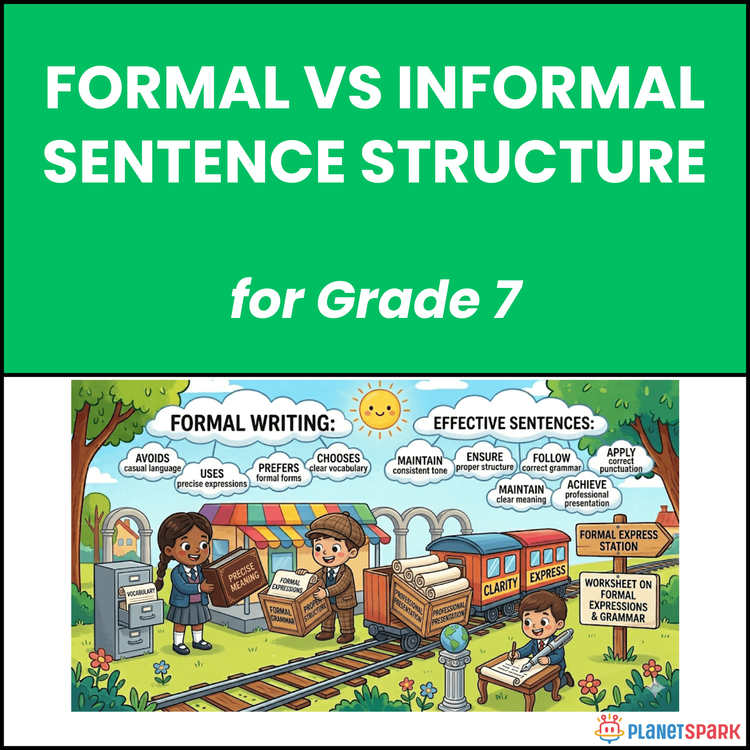
This Grade 7 worksheet on Formal vs Informal Sentence Structure helps students understand how language changes depending on purpose, audience, and situation. Through sentence comparison, rewriting activities, and structured writing practice, learners develop the ability to use formal language in academic and professional contexts while recognizing informal everyday expressions.
Why Formal and Informal Sentence Structure Matter in Grammar?
Understanding formal and informal language helps students communicate appropriately in different situations. For Grade 7 learners, this topic is important because:
1. It improves communication skills in academic and social settings.
2. It helps students recognize appropriate tone and vocabulary.
3. It strengthens sentence structure, grammar accuracy, and clarity.
4. It builds confidence in formal writing and presentations.
What’s Inside This Worksheet?
Students move from identifying formal and informal expressions to rewriting and constructing formal sentences through guided grammar practice.
🧠 Exercise 1 – Identify Formal and Informal Sentences
Students underline formal sentences and circle informal sentences to recognize differences in tone, contractions, and vocabulary usage.
✏️ Exercise 2 – Multiple Choice Questions
Students choose sentences that correctly use formal language, polite structure, and professional vocabulary.
📋 Exercise 3 – Sentence Rewriting
Students rewrite informal sentences using full forms, formal vocabulary, polite expressions, and professional phrasing.
📝 Exercise 4 – Fill in the Blanks
Students complete a grammar passage using words related to tone, vocabulary, sentence structure, grammar rules, and formal writing conventions.
✍️ Exercise 5 – Paragraph Writing
Students write a 6–8 sentence paragraph on “A School Event I Enjoyed” using formal language and avoiding contractions. They must maintain a polite and professional tone throughout the paragraph.
A strong response will include formal expressions such as “I cannot attend the meeting today.” instead of “I can’t come to the meeting today.” and “Please confirm your attendance.” instead of “Tell me if you’re coming.”
✅ Answer Key (For Parents & Educators)
Exercise 1 – Formal and Informal Sentences
1. Formal – I cannot attend the meeting today.
2. Informal – I can’t come to the meeting today.
3. Formal – Please submit the assignment by tomorrow.
4. Informal – Send the assignment by tomorrow.
5. Formal – I would like to request your help.
6. Informal – I wanna ask for your help.
7. Formal – The results were not satisfactory.
8. Informal – The results weren’t good.
9. Formal – Kindly wait for further instructions.
10. Informal – Hang on till they tell us more.
Exercise 2 – Multiple Choice Questions
1. b) I cannot complete the work today.
2. a) Please provide the details.
3. a) I would like to inform you about the change.
4. b) The work was not done properly.
5. c) Kindly review the document.
6. b) I did not understand the instructions.
7. c) We require additional information.
8. a) He did not attend the session.
9. c) Please confirm your attendance.
10. a) The task was completed successfully.
Exercise 3 – Sentence Rewriting (Sample Answers)
1. I cannot finish the work today.
2. Please send me the details.
3. I would like to ask for help.
4. The results were not satisfactory.
5. Kindly wait here.
6. Please give me the file.
7. I did not understand this.
8. We require additional information.
9. He did not attend.
10. Please share your decision.
Exercise 4 – Fill in the Blanks
1. informal
2. formal
3. full
4. precise
5. formal
6. sentence
7. standard
8. punctuation
9. sentence
10. polished
Exercise 5 – Paragraph Writing (Sample Answer)
A School Event I Enjoyed
Last month, our school organized a science exhibition for all students. I participated in the event with two classmates from my section. We prepared a working model that explained water conservation methods. The judges appreciated our presentation because it was informative and well organized. Many students visited our stall and asked thoughtful questions. The event helped me improve my confidence and communication skills. It was an educational and memorable experience for everyone involved.
Help your child develop confident communication skills through structured grammar practice that strengthens formal writing, sentence clarity, and appropriate language usage.
🔖Book a free trial!
Frequently Asked Questions
Formal style uses proper grammar and complete words, while informal style includes casual language and contractions.
It prepares students for exams and academic communication.
By replacing slang, avoiding contractions, and using proper sentence structure.