
Class 7 Worksheet on Concise and Redundant Expressions
Class 7Free DownloadPDF

Arzoo KhanVisit Profile
I’m a friendly and dedicated English teacher who helps children learn with confidence and ease. I create a comfortable and supportive environment where students are not afraid to make mistakes and are encouraged to believe in themselves.
Class 7 Worksheet on Concise and Redundant Expressions
Class 7Free DownloadPDF
Arzoo KhanVisit Profile
I’m a friendly and dedicated English teacher who helps children learn with confidence and ease. I create a comfortable and supportive environment where students are not afraid to make mistakes and are encouraged to believe in themselves.
Say It Better: Concise vs Redundant Expressions for Class 7
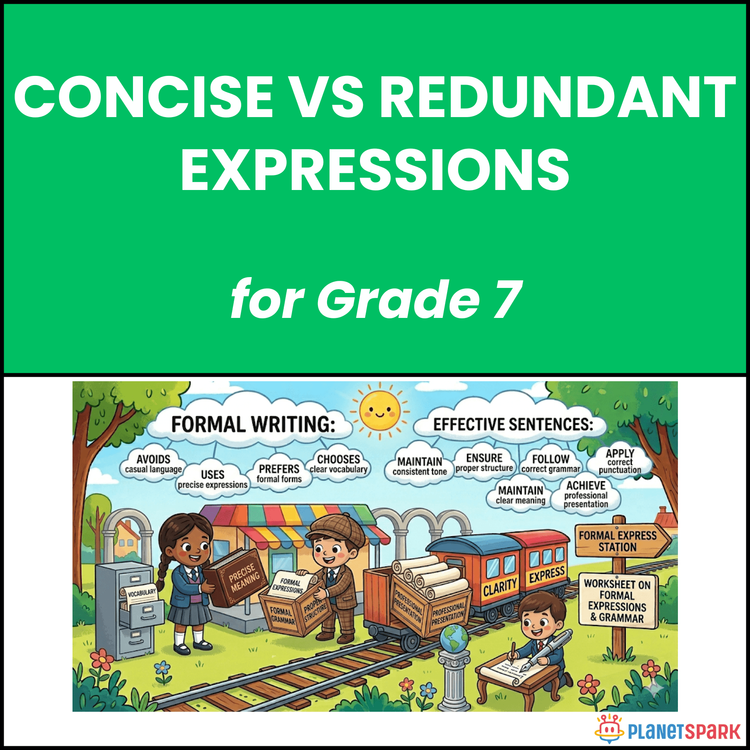
This Grade 7 worksheet on Concise vs Redundant Expressions helps students learn how to remove repeated meaning, unnecessary wording, and extra phrases to create clearer and stronger sentences. Through sentence correction, rewriting activities, and concise writing practice, learners improve grammar accuracy, sentence clarity, and effective communication skills.
Why Concise and Redundant Expressions Matter in Grammar?
Redundant expressions make writing repetitive and less effective. Learning to write concisely is important for Grade 7 students because:
1. It improves sentence clarity and readability.
2. It helps students avoid repeated meaning and unnecessary wording.
3. It strengthens sentence construction and vocabulary usage.
4. It encourages precise and confident communication.
What’s Inside This Worksheet?
Students move from identifying redundant expressions to rewriting and constructing concise sentences through guided grammar practice.
🧠 Exercise 1 – Identify Concise and Redundant Sentences
Students underline concise sentences and circle redundant sentences to recognize repeated ideas and extra wording.
✏️ Exercise 2 – Multiple Choice Questions
Students choose the clearest and most concise sentence from different sentence options.
📋 Exercise 3 – Sentence Rewriting
Students rewrite redundant sentences by removing repeated meaning, unnecessary words, and duplicated expressions.
📝 Exercise 4 – Fill in the Blanks
Students complete a grammar passage using words related to concise phrasing, redundancy, sentence clarity, and logical structure.
✍️ Exercise 5 – Paragraph Writing
Students write a 6–8 sentence paragraph on “My Favorite Weekend Activity” using concise sentences and avoiding repetition. They must remove unnecessary wording and avoid repeated ideas while maintaining clear sentence flow.
A strong response will include concise expressions such as “She returned home.” instead of “She returned back home.” and “The result was final.” instead of “The result was absolutely completely final.”
✅ Answer Key (For Parents & Educators)
Exercise 1 – Concise and Redundant Sentences
1. Redundant – The boy returned back home.
2. Concise – The boy returned home.
3. Redundant – She repeated the same answer again.
4. Concise – She repeated the answer.
5. Redundant – They joined together as a team.
6. Concise – They formed a team.
7. Concise – The teacher explained the topic clearly.
8. Redundant – The teacher explained the topic in a clear way.
9. Concise – The dog barked loudly at night.
10. Redundant – The dog barked loudly during the night time.
Exercise 2 – Multiple Choice Questions
1. b) She returned home.
2. b) He repeated the mistake.
3. a) They formed a team.
4. c) The teacher explained the topic clearly.
5. b) The dog barked loudly at night.
6. a) She shouted loudly.
7. b) He finished the work.
8. c) They planned.
9. c) The result was final.
10. b) She added the numbers.
Exercise 3 – Sentence Rewriting (Sample Answers)
1. She returned home.
2. He repeated the mistake.
3. They formed a team.
4. The teacher explained the topic clearly.
5. The dog barked loudly at night.
6. She shouted loudly.
7. He finished the work.
8. They planned.
9. The result was final.
10. She added the numbers.
Exercise 4 – Fill in the Blanks
1. repeated
2. extra
3. unnecessary
4. repeated
5. concise
6. sentence
7. word
8. proper
9. grammar
10. writing
Exercise 5 – Paragraph Writing (Sample Answer)
My Favorite Weekend Activity
My favorite weekend activity is playing badminton with my friends. We meet at the park every Saturday evening. The game keeps us active and energetic. We practice new shots and enjoy friendly matches together. After playing, we sit under the trees and share snacks. Sometimes we talk about school and upcoming events. The activity helps me relax and spend quality time with my friends.
Help your child build stronger writing skills through concise sentence practice that improves grammar clarity, precision, and effective communication.
🔖Book a free trial!
Frequently Asked Questions
Concise expressions are clear and brief, while redundant expressions repeat the same idea unnecessarily.
They may think longer sentences sound better, but it often reduces clarity.
By identifying repeated ideas and rewriting them in fewer words without losing meaning.