
Class 5 Grammar Worksheet on Parentheses and Commas

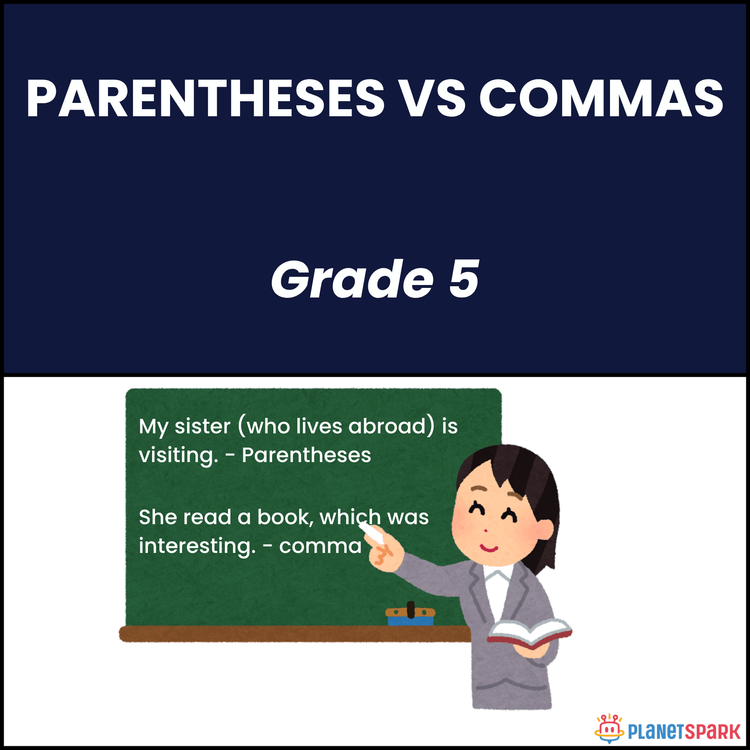
Class 5 Grammar Worksheet on Parentheses and Commas
Parentheses vs Commas: Strengthening Grammar Skills for Class 5
This Grade 5 worksheet focuses on the proper use of parentheses and commas. Students will practice using these punctuation marks to provide extra information, separate ideas, and clarify meanings in sentences. The exercises, such as multiple choice, true/false, fill-in-the-blanks, and sentence rewriting, help students understand the rules for using parentheses and commas effectively. This worksheet ensures students become proficient in punctuation, improving both their written and spoken communication skills.
Why Parentheses and Commas Matter in Grammar?
Parentheses and commas are essential punctuation marks that help writers add clarity, provide extra details, and separate ideas in sentences. For Grade 5 learners, this is important because:
1. Parentheses add extra, non-essential information to a sentence.
2. Commas separate ideas and items in a list, making writing clearer.
3. Correct usage of parentheses and commas enhances sentence structure and readability.
4. Mastering punctuation helps students write more naturally and express themselves accurately.
What’s Inside This Worksheet?
This worksheet includes five engaging activities designed to teach proper use of parentheses and commas:
Exercise 1 – Choose the Correct Sentence
Students choose the correct sentence that uses commas or parentheses correctly. Example: “She read a book (which was interesting).”
Exercise 2 – True or False
Students determine whether the sentences use parentheses and commas correctly.
Exercise 3 – Fill in the Blanks
Students complete sentences by filling in the blanks with parentheses or commas.
Exercise 4 – Sentence Rewriting
Students rewrite sentences using the correct punctuation marks.
Exercise 5 – Paragraph Writing
Students write a paragraph using parentheses and commas correctly to add extra information.
Answer Key (For Parents & Educators)
Exercise 1 – Correct Sentences
1. c) My sister, who lives abroad, is visiting.
2. c) Ravi met his uncle (who is a pilot yesterday).
3. b) Meera went to Jaipur (a pink city).
4. a) Asha visited Delhi (the capital city) last week.
5. b) Raj saw the Ganga (a holy river).
6. a) They met Riya (who is my cousin) in school.
7. b) She read a book (which was interesting).
8. c) Riya (my best friend) helped me with my homework.
9. a) The dog (a very friendly animal) wagged it’s tail happily.
10. c) My brother (who lives in Delhi) is coming today.
Exercise 2 – True or False
1. True
2. False
3. True
4. True
5. False
6. True
7. True
8. False
9. False
10. True
Exercise 3 – Fill in the Blanks
1. My cousin (who lives in Jaipur) is visiting us this weekend.
2. The book (which I borrowed from library) was very interesting.
3. Our class teacher (who teaches us English) is absent today.
4. The cake (baked by my mother) tasted delicious.
5. The boy (from my class) won the race.
6. The movie (we watched yesterday) was very funny.
7. My uncle (who lives in Delhi) is a doctor.
8. The park (near my house) is closed today.
9. The girl (wearing a red dress) is my neighbor.
10. The shop (at the corner of the street)
is very popular.
Exercise 4 – Sentence Rewriting
1. comma- parentheses
2. full stop- comma
3. parentheses- optional
4. parentheses- clauses
5. remove- insert
6. phrases- clauses
7. necessary- optional
8. dash- brackets
9. sentences- clauses
10. main idea- extra info
Exercise 5 – Paragraph Writing
Riya visited Delhi (the capital of India) during summer. She met her uncle, who is a doctor, and explored markets. Later, she went to Jaipur, a pink city, and enjoyed the trip. She visited many historical sites, one of which was a famous fort. Riya also tried local foods, she loved the traditional flavors. In the evening, she walked around the city, watching the sunset. She also took a few photos, which she later shared with her friends. After visiting these cities, Riya felt happy, knowing she had made the most of her summer trip. The memories of her visit remained vivid, she couldn’t wait to plan her next adventure somewhere equally exciting.
Or
Answers may vary.
Help your child master punctuation with this fun and interactive worksheet on parentheses and commas.
Frequently Asked Questions
Parentheses are used to add extra information or clarify a point without disrupting the main sentence.
Commas should separate items in a list to make the sentence clearer and easier to read.
By using conjunctions or semicolons to join independent clauses instead of just commas.