
Class 5 Grammar Worksheet on Dash and Colon Usage

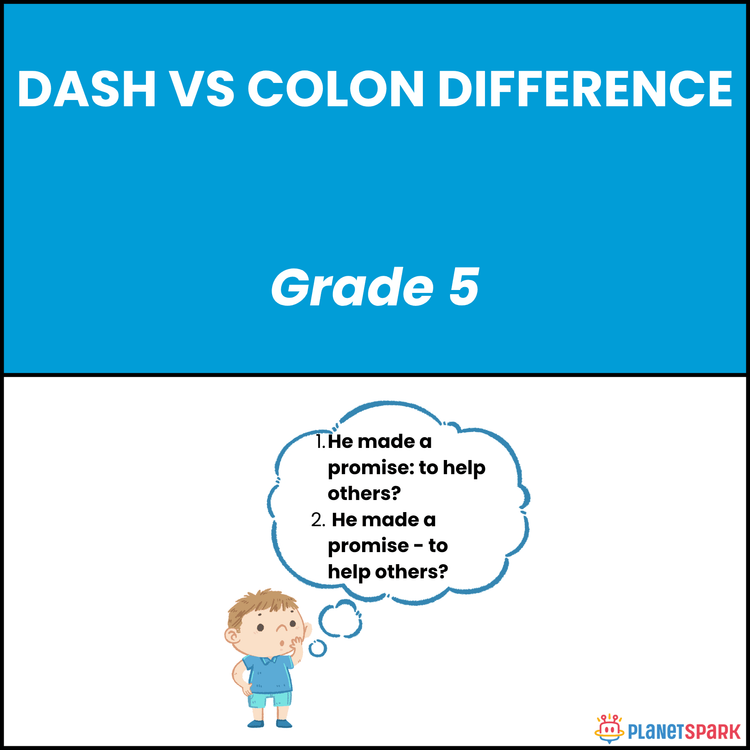
Class 5 Grammar Worksheet on Dash and Colon Usage
Dash vs Colon Difference: Mastering Grammar for Class 5
This Grade 5 worksheet focuses on the important difference between dashes and colons, emphasizing their unique roles in writing. Through engaging exercises like multiple choice, true/false, fill-in-the-blanks, and sentence rewriting, students practice using these punctuation marks to enhance clarity and meaning in their writing. This worksheet helps students understand when and how to use dashes and colons effectively.
Why Dash vs Colon Matters in Grammar?
Understanding the difference between dashes and colons is essential for strong writing. For Grade 5 learners, this topic is important because:
1. Colons introduce lists, explanations, and examples.
2. Dashes create a strong break in thought or add emphasis.
3. Both punctuation marks add clarity and structure to writing.
4. Mastering their use improves writing fluency and readability.
What’s Inside This Worksheet?
This worksheet includes five interactive exercises to help students understand the difference between dashes and colons:
Exercise 1 – Choose the Correct Sentence
Students select the correct sentence using dashes or colons for emphasis. Example: “She had one dream: to succeed.”
Exercise 2 – True or False
Students evaluate whether sentences follow the correct rules for using dashes or colons.
Exercise 3 – Fill in the Blanks
Learners fill in sentences with either a dash or a colon to complete the thought.
Exercise 4 – Error Correction
Students find and replace incorrect punctuation in sentences related to dashes and colons.
Exercise 5 – Paragraph Completion
A story-based activity where students apply punctuation rules to complete sentences and paragraphs correctly.
Answer Key (For Parents & Educators)
Exercise 1 – Correct Sentences
1. b) She had one dream—to succeed.
2. a) He made a promise: to help others.
3. b) The box contained items: toys, books and games.
4. c) She had one aim- to win
5. a) The teacher explained the rule: be honest.
6. b) He brought supplies: rope, torch and water.
7. b) The had one plan: to escape.
8. a) She remembered one thing- never give up.
9. c) The shop sells many things: fruits, vegetables and snacks.
10. c) He had one goal- to succeed.
Exercise 2 – True or False
1. False
2. True
3. True
4. False
5. True
6. True
7. False
8. True
9. False
10. False
Exercise 3 – Fill in the Blanks
1. ---
2. :
3. :
4. —
5. :
6. :
7. ---
8. :
9. ---
10. :
Exercise 4 – Error Correction
1. dash
2. colon
3. dash
4. sentence
5. emphasis
6. list
7. break
8. colon
9. explanation
10. colon
Exercise 5 – Paragraph Completion
1. ---
2. —
3. :
4. —
5. ---
6. :
7. ---
8. —
9. :
10. —
Help your child master the difference between dashes and colons with easy-to-follow grammar exercises.
Frequently Asked Questions
Dashes are used to create emphasis or introduce additional information, while colons introduce lists or explanations.
Use a dash to create a break in thought or add emphasis, while colons should be used before lists or explanations.
By completing exercises that require selecting or inserting the correct punctuation mark in different sentence structures.